
Cold plunges may help with post-exercise soreness in some settings, but the evidence does not support treating every advertised benefit as established. Recovery, muscle growth, stress, sleep, and immunity are different outcomes. A study that supports one cannot establish the others.
This article looks at those outcomes separately. If you want preparation and safety basics first, start with our cold plunge beginner guide. Here, the aim is to help you read a benefit claim more carefully and understand what a personal tracking app can add.
Which cold plunge benefits have research behind them?
The strongest useful distinction is between recovery after a specific exercise session and broader health or wellbeing claims. Research also varies by the comparison group, participants, timing, and measurement. “Cold plunges work” leaves all of those details unanswered.
Scroll to read the full table →
| Outcome | What the evidence discussed below suggests | What it does not establish |
|---|---|---|
| Post-exercise soreness | Some reviews find improvements compared with passive recovery; findings are not uniform. | Better recovery after every sport or workout. |
| Athletic performance | Effects differ across power, strength, and timing of the test. | A universal performance boost. |
| Muscle growth | Repeated immersion immediately after lifting may have a tradeoff. | That feeling less sore means greater training adaptation. |
| Stress and sleep | Some promising findings, with important limits. | Reliable benefits for everyone or a clinical treatment. |
| Immunity | A large shower trial found less reported sick leave, without fewer illness days. | Proof that plunging prevents illness. |
The sources below explain why these distinctions matter. The table is an editorial summary, not a ranking of treatments or a personalized recommendation.
Can cold plunges reduce soreness after exercise?
There is evidence for reduced soreness in particular exercise settings. A 2022 review by Moore and colleagues pooled 52 studies and separated high-intensity exercise from eccentric exercise, where muscles lengthen under load. After high-intensity exercise, cold-water immersion improved soreness and perceived recovery at the 24-hour assessment compared with passive recovery.
Performance results were more selective. Muscular power improved at that follow-up in both exercise groups, while strength recovery did not show a significant improvement. That distinction matters if your real question is about the next workout rather than how your legs feel.
A 2026 review by Bustos Carvajal and colleagues, covering eight studies of hot and cold immersion, found no consistent improvement in soreness or perceived recovery versus controls. Its narrower collection of studies and outcomes differs from the earlier review. The newer date alone does not make one paper a final answer.
Read these findings as evidence with boundaries. Ask what exercise preceded the immersion, what the researchers compared it with, and when they checked the result. A soreness rating tomorrow and an immediate power test answer different questions.
What is the tradeoff after strength training?
Short-term recovery and long-term muscle growth should be considered separately. A 2024 meta-analysis by Piñero and colleagues suggests that regularly using cold-water immersion immediately after resistance training may reduce hypertrophy, or muscle-growth adaptation, compared with resistance training alone.
The review included eight studies of fair to poor quality, so the finding needs caution. This does not establish that any cold exposure at any time prevents muscle growth. It concerns the studied post-training practices. It does mean that “less sore” and “better for building muscle” cannot be used interchangeably.
For example, an athlete facing closely spaced events and someone prioritizing a long lifting block may be asking different recovery questions. Discuss that context with a qualified coach or healthcare professional instead of making every workout end with the same routine because it is popular.
Do cold plunges help stress, sleep, or mood?
The evidence is developing. A 2025 PLOS ONE review by Cain and colleagues included 11 randomized studies. Stress was lower at a 12-hour follow-up, but not across all assessed times. Some sleep and quality-of-life findings were promising; a mood benefit was not established.
The sample headline needs context: 3,018 of the 3,177 participants came from one cold-shower trial. The other studies enrolled men only. A large combined participant count therefore does not mean every outcome was tested in thousands of diverse participants.
Feeling calmer or more awake after your own session is an experience worth recording. It is not enough to establish a lasting benefit or explain its cause. The setting, expectations, and other changes in your day may matter too.
Does cold plunging boost immunity?
The frequently repeated sick-leave finding comes from a shower study, not a trial showing that ice baths prevent infections. In Buijze and colleagues’ 2016 randomized trial, 3,018 adults were assigned to a hot-to-cold shower routine or a control group.
The intervention groups reported 29% less sickness absence from work, but there was no significant difference in reported illness days. Those are different measures. People taking less sick leave does not automatically mean they became ill less often.
The result also should not be transferred unchanged from a shower routine to tub immersion. When reading a claim, check the original activity and outcome rather than repeating the strongest version of a headline.
How can you judge a cold plunge claim?
A useful claim identifies the people, activity, comparison, and outcome. Before changing an existing routine, ask:
- Who was studied? Healthy adults, trained athletes, and people with a health condition are not interchangeable groups.
- What was tested? A shower, seated tub immersion, and swimming combine different exposures and activities.
- Compared with what? A result against passive recovery does not compare every other recovery option.
- What changed, and when? Subjective soreness, power, and next-night sleep are separate measurements.
- What were the limitations? Sample size, missing observations, and study quality should travel with the headline.
The same discipline helps with personal data. Cochrane’s guidance on observational evidence explains how other factors can affect both the choice of an activity and its outcome. A pattern between plunge days and sleep could also reflect how you schedule exercise or rest. This is our application of that methodological principle to a personal log.
Use PlungeLab to observe your routine more clearly
PlungeLab helps you keep the record behind the question. Session capture and history are free: record from Apple Watch, or log manually on iPhone. Notes can preserve details such as training context and how the session felt.
Optional PlungeLab Pro Insights compare available Apple Health outcomes across your recorded days. These are personal associations, not clinical results or proof that cold water caused a change. The plunge-versus-rest comparison needs at least eight usable days in each group, and missing Health data can limit what appears.
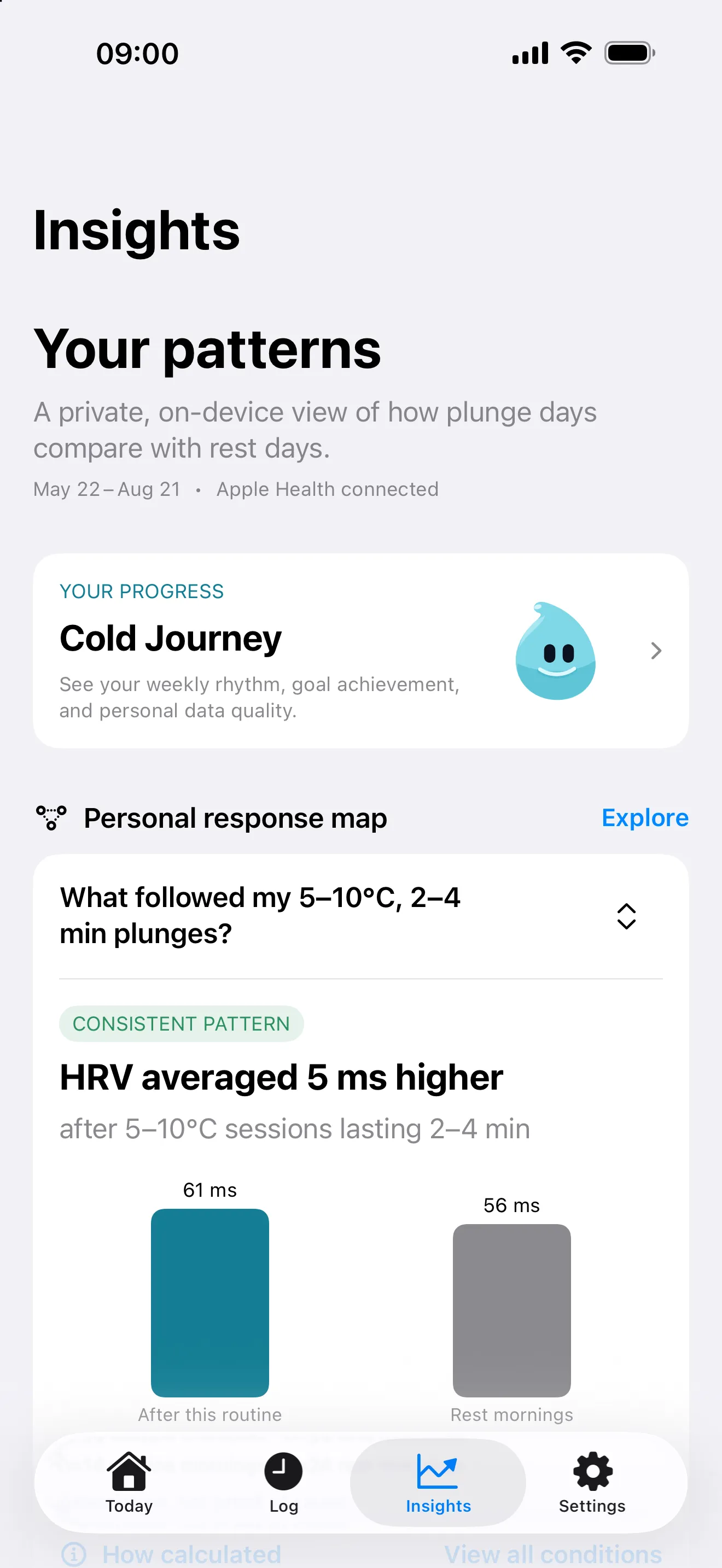
The annual Pro plan offers a seven-day free trial for eligible customers, with current terms in Apple’s purchase sheet. It renews into a paid annual subscription unless canceled. Check the price, eligibility, renewal date, and cancellation terms before subscribing; the trial does not guarantee enough data for a personal comparison.
Download PlungeLab to keep your routine on record. You can use the free log without a Watch or a Pro subscription. PlungeLab requires iOS 26+ on iPhone and watchOS 11+ for wrist capture.
Frequently asked questions
Is feeling energized evidence that a cold plunge improved my health?
It is a subjective observation from that occasion. Keep the note if it matters to you, but distinguish it from a measured, lasting outcome. Neither a pleasant sensation nor a change in an app metric proves cause and effect.
Is cold plunging appropriate for everyone?
No. The RNLI describes sudden breathing changes and increased heart rate and blood pressure with cold-water shock. Discuss suitability with a healthcare professional, especially with cardiovascular concerns. An app reading cannot establish safety.
Where can I learn about temperature and duration?
Our temperature and duration guide explains study conditions and measurement. It does not prescribe an exposure target.
Sources and editorial approach
Written by the PlungeLab team, with links to our product. We distinguish published findings, our interpretation, and illustrative app data. This article has not been medically reviewed and does not claim that PlungeLab produces any of the studied outcomes.
- Moore et al., Sports Medicine (2022): recovery after strenuous exercise.
- Bustos Carvajal et al., Frontiers in Sports and Active Living (2026): water immersion and sports recovery.
- Piñero et al., European Journal of Sport Science (2024): postexercise immersion and hypertrophy.
- Cain et al., PLOS ONE (2025): health and wellbeing review.
- Buijze et al., PLOS ONE (2016): cold shower randomized trial.
- Cochrane Handbook, Chapter 25: bias in observational studies.
- RNLI: cold-water shock.

Free session capture and history for iPhone and Apple Watch. Talk to the team.