
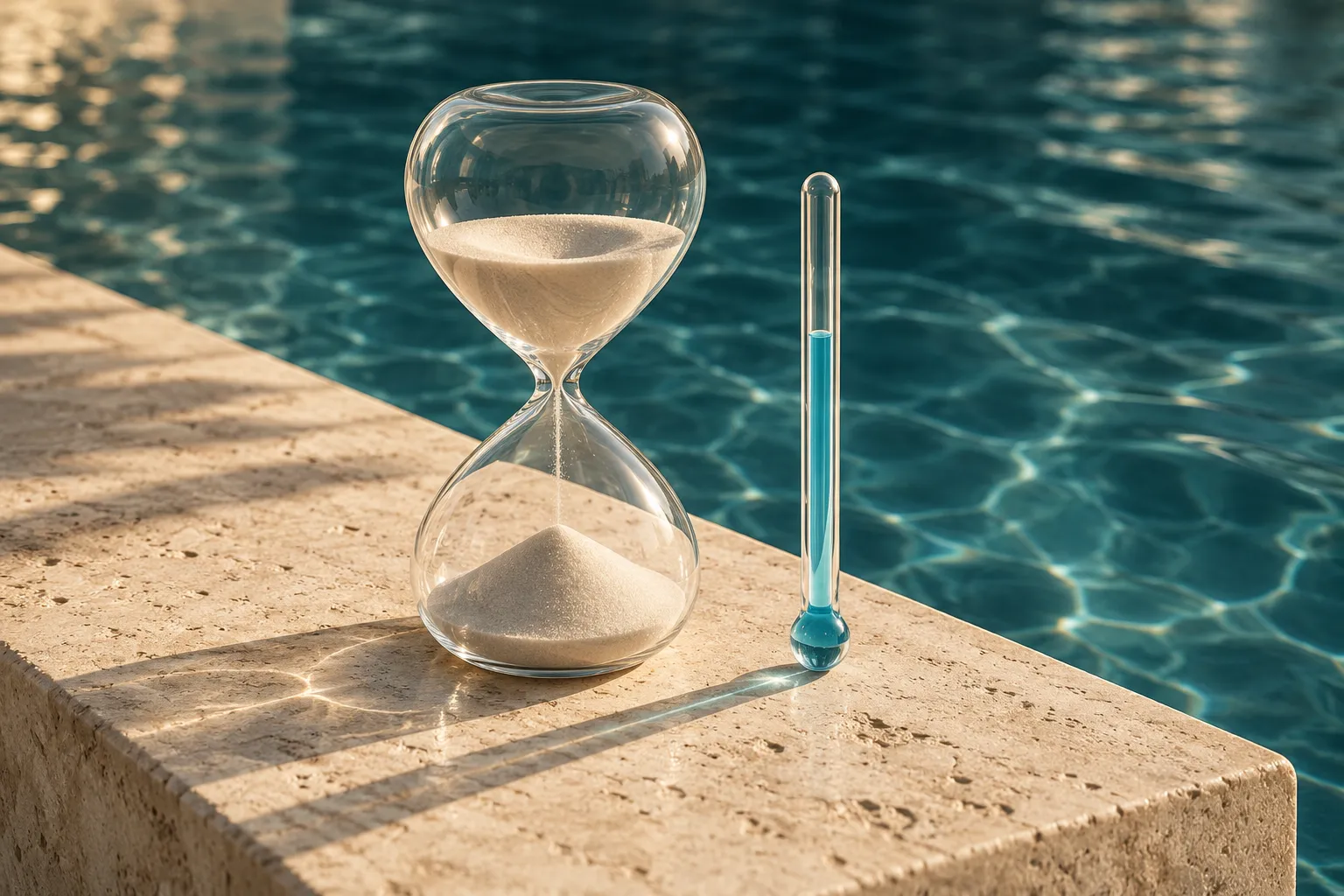
There is no single cold plunge temperature and duration established as suitable for everyone. Research tests particular combinations in particular people and settings. Those numbers help describe a study; they do not provide personal clearance or a universal “best” ice bath.
This guide explains how to interpret the numbers you see and how to record them accurately. For preparation, use our beginner guide. For the evidence behind different outcomes, read Cold Plunge Benefits: What the Research Shows.
Why do cold plunge recommendations give different numbers?
They may be answering different questions. A study of soreness after a football match and a study of wellbeing in healthy adults need not use the same activity, timing, or outcome. Quoting only the water temperature removes the context needed to understand the result.
In a 2016 review by Machado and colleagues, researchers examined nine post-exercise studies with 169 participants. They found better soreness results in the 11–15°C and 11–15-minute categories, while emphasizing small effects and low study quality. Those are research categories, not instructions to stay in cold water for that time.
The authors analyzed temperature and duration separately. The category findings do not establish that every individual combination was directly compared under identical conditions. A headline that turns the result into one precise prescription adds certainty the study does not supply.
The 2022 Moore review also examined temperature and duration, finding relationships for selected outcomes after high-intensity exercise. Its results were outcome-specific. A relationship involving a blood marker or an endurance test does not establish the same target for sleep, mood, or personal safety.
The 2025 wellbeing review combined varied immersion protocols and a shower trial, and called for more work on optimal protocols. Different evidence questions explain some of the variation in the numbers quoted online.
Read a protocol as more than temperature plus minutes
A research protocol includes who participated, what they did before immersion, how they entered the water, the exposure itself, and what happened afterward. When comparing two papers, keep those details attached to the measurements.
Scroll to read the full table →
| Detail to check | Question it answers |
|---|---|
| Participants | Were these trained athletes, healthy adults, or a different group? |
| Activity | Was the exposure a shower, tub immersion, or swimming? |
| Temperature | Was water temperature measured, and how was it reported? |
| Duration and rounds | Was it one continuous exposure or multiple separate bouts? |
| Immersion depth | What part of the body was immersed? |
| Timing | Did immersion follow exercise, and when was the outcome assessed? |
| Comparator | Was the alternative sitting quietly, active recovery, or something else? |
These questions are a reading checklist, not a recipe. For example, the large 2016 Buijze trial tested hot-to-cold showers. Its reported sick-leave result cannot identify the ideal tub temperature or prove that the same duration has an equivalent effect during immersion.
Is colder water always better?
The evidence discussed here does not establish a “colder is better” rule. Temperature findings concern the measured outcome and the studied setting. Risk also cannot be reduced to whether a temperature falls inside a popular range.
The RNLI highlights cold-water shock at 15°C / 59°F and below, including involuntary gasping and changes in heart rate and blood pressure. That threshold is a risk warning. It is not a recommended target, and it does not mean water above it is harmless.
The US National Weather Service also warns that sudden immersion can disrupt breathing, and that cooling can continue after leaving the water. A normal-looking timer or heart-rate display does not assess these risks.
Discuss whether cold immersion is appropriate for you with a healthcare professional. If you choose to proceed, arrange supervision and an accessible exit. Leave when needed, regardless of a countdown. More minutes, a lower number, or completing an app target is not evidence of a better session.
How do Celsius and Fahrenheit compare?
Celsius and Fahrenheit describe the same temperature on different scales. A log is easier to interpret when the unit is clear. The conversion is °F = (°C × 9/5) + 32; to reverse it, °C = (°F − 32) × 5/9.
| Celsius | Fahrenheit |
|---|---|
| 5°C | 41°F |
| 10°C | 50°F |
| 15°C | 59°F |
| 20°C | 68°F |
This table is unit conversion only. It does not define safe ranges, recommended temperatures, or progression steps. A session note saying “50 degrees” is ambiguous until you know the unit.
Record the measured session, not the intended one
An accurate log distinguishes what happened from what you planned. If you ended early, the actual duration belongs in the record. If you did not measure the water, leaving temperature blank is more informative than inserting a familiar number.
It also helps to distinguish a chiller’s setting, a separate thermometer reading, and a reading supplied by a Watch sensor. They are different sources. A setting can be recorded as context in your note, rather than silently treating it as a measurement of the water during that session.
Two entries with the same duration can therefore have different amounts of information:
- Entry A: actual duration saved, measured water temperature known, usual tub noted.
- Entry B: actual duration saved, water temperature unknown, different setting noted.
Entry B is still a useful record. The missing reading should remain missing. It is better to preserve the distinction than to make the entries look equally complete.
Use PlungeLab for time and temperature records
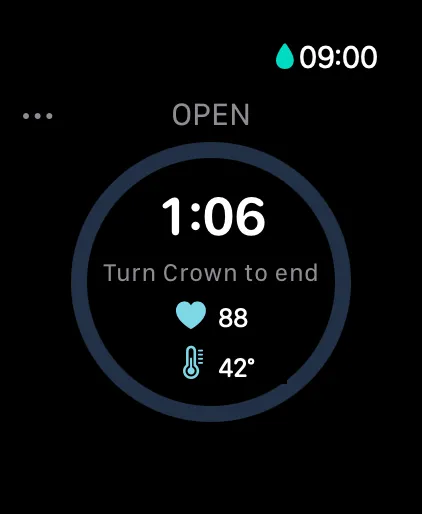
PlungeLab’s free Apple Watch capture records elapsed time and available heart-rate readings. You can choose an open-ended recording by leaving the target off, or use the optional timed control for an already planned session. The timer is a recording tool, not a safety limit or exposure recommendation.
Apple Watch Series 10 or later and Apple Watch Ultra (not SE) can add sensor temperature when the capability is available and readings are supplied. Other supported watches retain manual capture. Check a remembered manual temperature before reuse: today’s water may differ, and you can clear an unknown value.
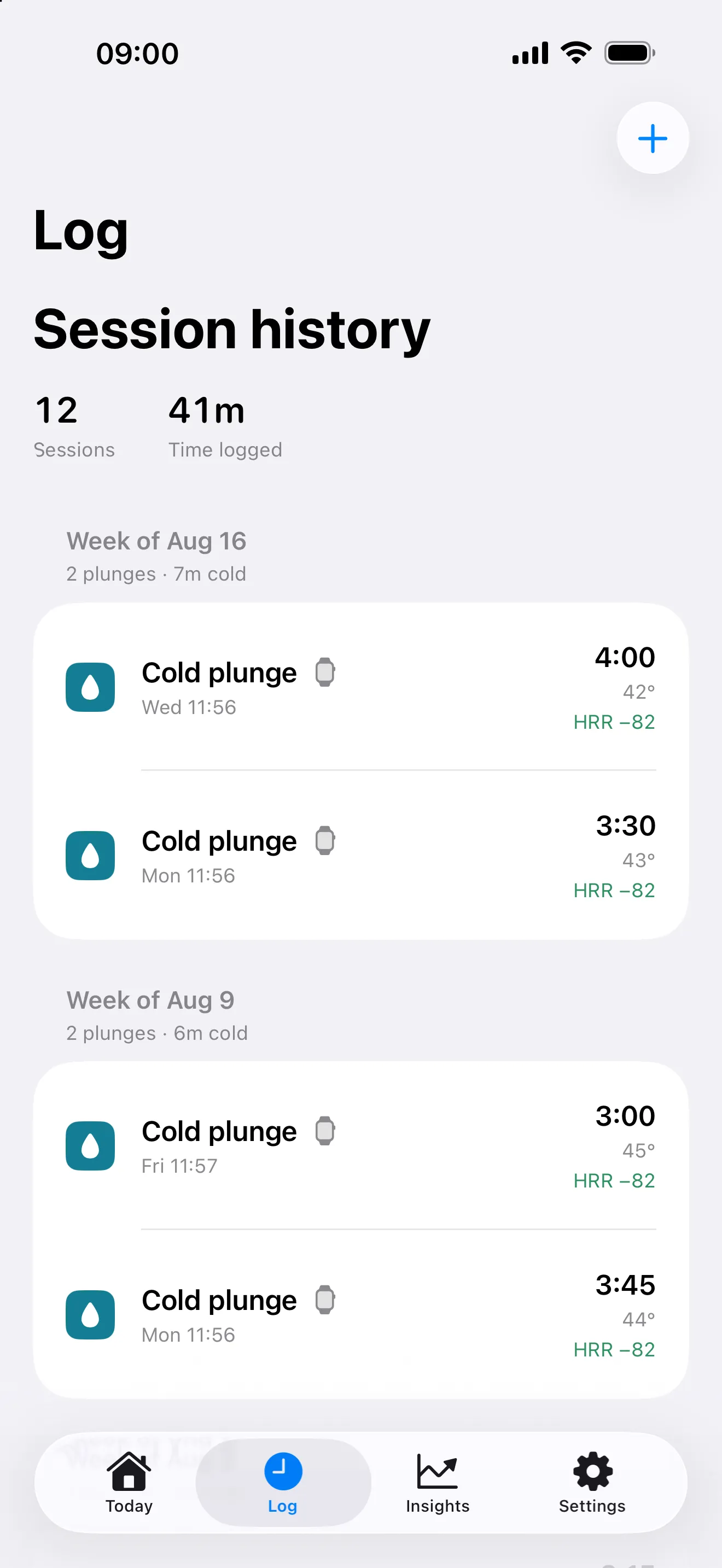
Without a Watch, you can log the actual session manually on iPhone. Capture and history are free. Optional Pro tools include personal analysis and export; the annual Pro plan offers a seven-day free trial for eligible customers. It renews into a paid annual subscription unless canceled. Confirm current price, eligibility, renewal date, and cancellation terms in Apple’s purchase sheet.
Get PlungeLab for iPhone on iOS 26+ and Apple Watch on watchOS 11+. Our Watch walkthrough explains the controls, while the journal guide covers the context worth keeping alongside the numbers.
Frequently asked questions
Do I need visible ice for a cold plunge?
No. Ice is not a temperature measurement. Record a measured water temperature when you have one rather than judging an exposure by the presence of ice.
Can I combine separate dips into one duration?
Keep enough detail to distinguish separate exposures from a continuous one. If a saved recording spans multiple dips, explain the breaks in its note. Equal totals do not describe identical sessions.
What should I do when there is no temperature reading?
Leave it blank and keep the duration and other known details. Neither an absent sensor reading nor an estimate should be presented as a measured value.
Sources and editorial approach
Written by the PlungeLab team. Research findings are presented as study observations; the conversion table is arithmetic and the recording checklist is our editorial guidance. This article has not been medically reviewed and does not prescribe temperature, duration, frequency, or progression.
- Machado et al., Sports Medicine (2016): temperature, immersion time, and soreness.
- Moore et al., Sports Medicine (2022): recovery review and meta-regression.
- Cain et al., PLOS ONE (2025): health and wellbeing protocols.
- Buijze et al., PLOS ONE (2016): cold shower trial.
- RNLI: cold-water shock.
- US National Weather Service: cold-water hazards.

Free session capture and history for iPhone and Apple Watch. Talk to the team.