
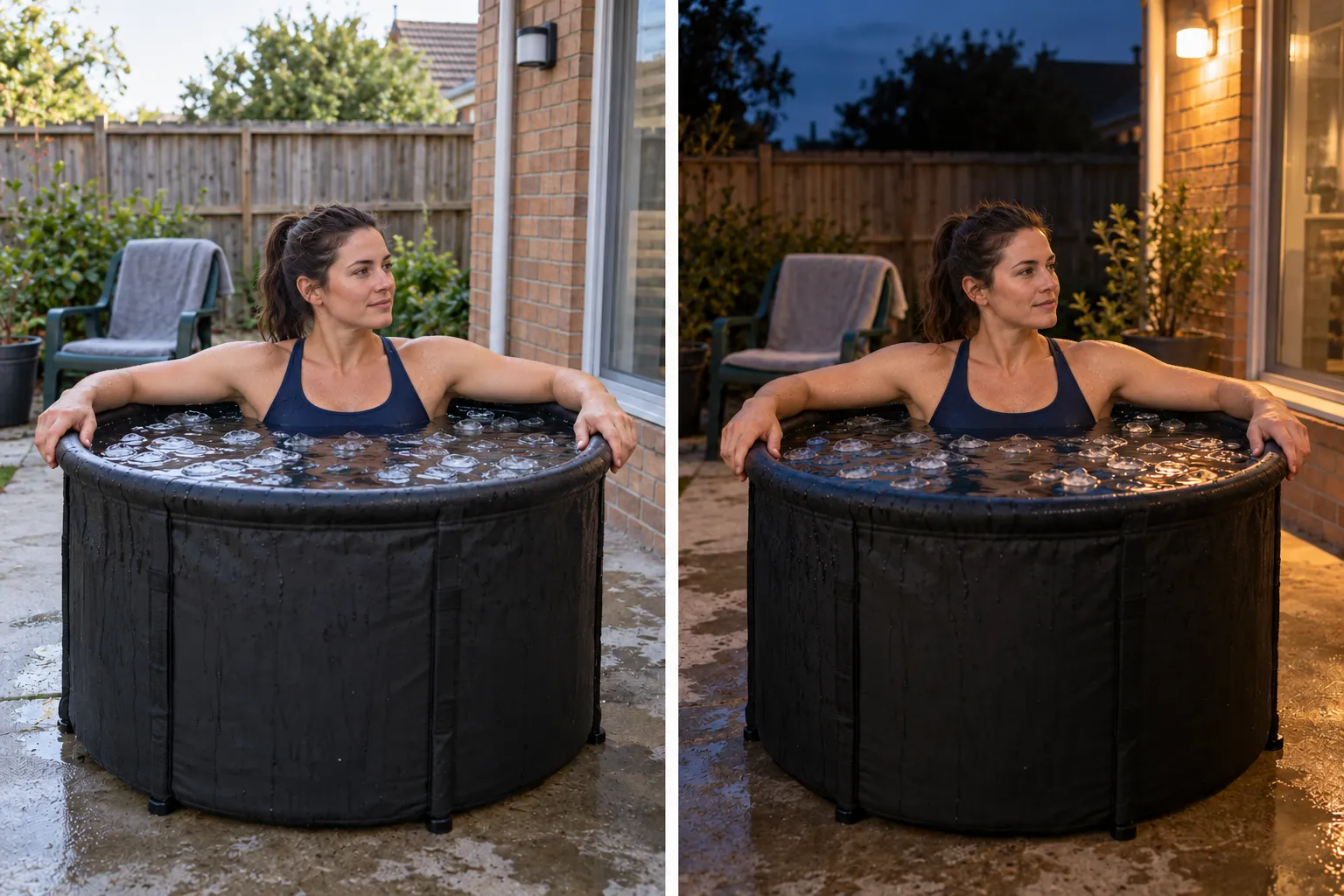
Research has not established whether morning or evening cold plunges are better. Small studies in men exercising before immersion found mixed sleep results, including no whole-night differences in one trial. These findings do not establish a universal bedtime cutoff or show that a recreational evening plunge will improve sleep.
You may have heard both “never plunge before bed” and “an evening ice bath helps you sleep.” Neither gives the full picture. The useful questions are what was studied, how timing fits your existing routine, and whether your own records show a consistent pattern. Here is how to separate those questions.
What the research says about evening plunges and sleep
The studies below examine different kinds of sleep outcomes. Feeling that you slept well, time asleep, and laboratory measurements of sleep stages are related questions, but they are not interchangeable results.
Scroll to read the full table →
| Research | What it found | What it does not establish |
|---|---|---|
| Robey et al., 2013: 11 trained male cyclists | No differences in whole-night sleep measures between control, evening exercise, and exercise followed by immersion. | That a plunge immediately before bed is suitable for everyone. |
| Chauvineau et al., 2021: 12 trained male runners | Fewer arousals after the immersion conditions; other sleep findings depended on immersion depth. | A general sleep benefit or a home exposure protocol. |
| Skein et al., 2018: 30 recreationally trained men across three groups | The paper’s abstract concludes that immersion had minimal effects on sleep during consecutive days of heat training. | That adding a nighttime plunge reliably improves sleep. |
The cyclist study used laboratory sleep recording after evening exercise. Its finding challenges a blanket claim that evening immersion necessarily disrupts sleep. It does not show that evening is better than morning.
The runner study also needs care: its whole-body condition included head immersion. The extra early-night slow-wave sleep finding was relative to partial immersion, not a general improvement over no immersion. That protocol is research context, not an instruction to submerge your head.
The 2025 PLOS ONE review by Cain and colleagues describes better subjective sleep scores from Skein’s experiment. That sits alongside the original paper’s more cautious overall conclusion. A subjective score and the full set of sleep measurements can tell different stories. The review and Skein paper also describe the same experiment; citing both does not create two independent positive trials.
Taken together, these sources support uncertainty. Small exercise-recovery studies in men do not settle the best time for an ordinary recreational routine.
Why mornings appeal
An existing morning routine may simply be easier to remember and organize. That is a practical reason to choose it, rather than evidence that morning cold exposure produces better health outcomes.
Cold exposure can also feel stimulating. RNLI’s cold-water shock guidance describes abrupt changes in breathing, heart rate, and blood pressure. Feeling more awake should not be confused with proof of improved concentration or a harmless response.
A 2025 time-of-day experiment compared morning and evening ice baths in six women and six men. It investigated hormone and blood-lipid responses. Although it directly compared times of day, it did not establish which schedule improves sleep. A physiological difference is not automatically a reason to rearrange your routine.
Before or after a workout?
Your training goal adds a separate consideration. A 2024 meta-analysis by Piñero and colleagues combined eight studies and found that cold-water immersion immediately after resistance training may reduce muscle-growth adaptations. The authors described the underlying evidence as generally fair to poor quality.
If muscle growth is a priority, that is a tradeoff to consider when evaluating regular post-lifting immersion. It is not a ban on cold exposure, evidence that every occasional plunge erases gains, or a basis for prescribing a universal waiting period.
The review also does not establish that plunging before a workout is the better option. “Before or after exercise?” and “morning or evening?” are different comparisons. Note the relationship to exercise in your journal so the two do not get mixed together.
Night plunges: practical considerations
There is no research-backed bedtime gap established by the studies above that applies to everyone. A brand’s rule about finishing several hours before bed should not be presented as a scientific consensus. Harvard Health likewise describes a lack of consensus about timing.
If you notice poorer sleep after evening sessions, record that pattern and reconsider the timing rather than pushing through to meet a schedule. There is no need to add sessions to test a theory.
Safety comes first:
- Never plunge alone or after alcohol. Evening convenience is not a reason to relax those precautions.
- Plan the surroundings. A clear, lit exit and another person matter. Outdoor darkness, changing weather, currents, and visibility add concerns that a bedtime calculation cannot solve. Follow RNLI’s open-water preparation guidance for that environment.
- Allow for warming up afterward. Continued cooling after exit is called afterdrop. The US National Weather Service warns that core temperature can keep falling after leaving cold water. Have dry clothing and a warm, sheltered place available; do not treat getting out as the end of the risk.
- Keep heat and contrast separate in your interpretation. Adding sauna changes the routine. These sleep studies do not establish a sauna–cold sequence or a bedtime schedule for contrast sessions.
Our beginner guide covers broader safety and preparation. Seek medical advice about suitability if you have heart, circulation, or blood-pressure concerns. A sleep score cannot provide clearance to plunge.
Compare your own morning and evening routine
A personal record can help you notice patterns. It cannot turn a home comparison into a clinical trial. The checklist below is an editorial method for organizing sessions you already choose to do.
- Choose one question first. For example: “How does my following night’s sleep duration compare?” Keep how awake you feel immediately afterward separate from next-morning HRV or resting heart rate.
- Record actual timing. Save when the session happened, your bedtime, session kind, actual duration, and temperature when known. Leave unknown measurements unknown. Our journal guide explains the fields.
- Keep other conditions comparable. Note exercise, caffeine, illness, travel, and changes to your sleep schedule. Comparing weekday mornings with weekend evenings may compare several habits at once. Use the same measurement source throughout.
- Review repeated observations, including gaps. Look at counts, averages, and variation. One good night cannot settle the question. Missing Health data is not a zero, and multiple sessions followed by the same night do not create independent nights of sleep.
- Keep “no clear difference” available. Do not increase cold exposure to accumulate data or chase a score. If the routine is inconvenient or sleep is worse, completing a comparison is not an obligation.
This applies the Cochrane Handbook’s explanation of confounding to a personal journal: other differences can help explain an apparent timing effect. More records do not automatically remove them.
Where PlungeLab fits
PlungeLab’s free capture and history keep the session record in one place. Record from Apple Watch or log manually on iPhone, then use notes for bedtime and other context. Optional Pro Insights connect sessions with available Apple Health outcomes on your devices.
The general plunge-day versus rest-day comparison needs eight usable days in each group. It compares recorded plunge days with days without a recorded cold session; it does not answer the separate morning-versus-evening question. Missing measurements and exclusions can reduce the usable counts.
These observations do not prove that cold exposure caused a difference or identify a safe exposure. HRV, resting heart rate, and sleep measure different things; a higher HRV value does not automatically mean better sleep.
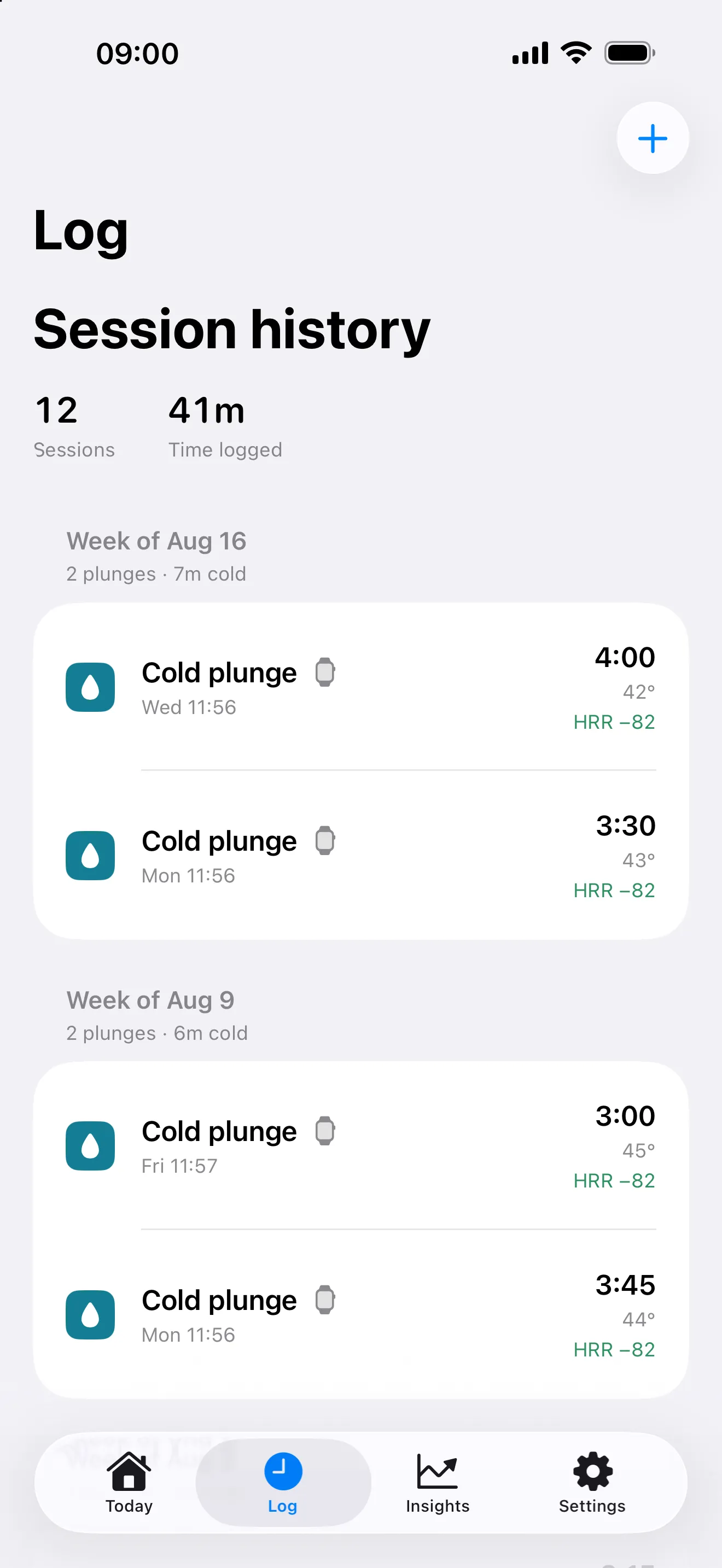
You can download PlungeLab to keep a free session history, then explore Pro if its comparisons fit your question. A purchase or trial does not guarantee sufficient data or a clear result.
Frequently asked questions
Is it better to cold plunge in the morning or at night?
The cited research does not establish a universal winner. Consider your existing routine, training goals, sleep observations, and the conditions needed to plunge safely.
How long before bed is too close?
These studies do not establish a universal cutoff. Record the actual gap and how you slept rather than adopting an exact number as a proven rule.
Can a cold plunge before bed improve sleep?
Some small post-exercise studies found changes in particular sleep measures; others found no whole-night differences or minimal effects. That does not establish an evening plunge as a reliable sleep aid.
What about a cold shower at night?
The immersion studies above do not settle nighttime shower timing. A large cold-shower trial focused on health and work outcomes, not a morning-versus-evening sleep comparison. Keep showers separate from tub sessions in your cold-shower log.
Does timing change next-morning HRV or resting heart rate?
The sources here do not establish a predictable next-morning advantage. Compare like-for-like measurements over repeated observations and retain their context. A single change cannot identify its cause.
Sources and editorial approach
Written by the PlungeLab team. Primary studies and the review are linked beside their findings; safety and methods sources support the relevant sections. Research and product source code were checked on October 21, 2026. This guide has not been medically reviewed. It prescribes no exposure temperature, duration, frequency, or bedtime gap.
Your data, your patterns — correlation, not medical advice.
Back to top ↑